

Derivitive bath for inflammation: the practice of perineal cooling
When discomfort settles in the lower body — heat, heaviness, tightness — many people look for a simple action to perform at home, in the evening, without complicated equipment. The "bain dérivatif" (derivative bath) is one of these ancient reflexes: cooling the perineum for a few tens of minutes, away from prying eyes. Here is what those who combine derivative baths and inflammatory discomfort are looking for, where this practice comes from, and how to carry it out concretely with a gel pack.
The derivative bath, in a few words
The derivative bath consists of keeping a specific area of the body cool: the perineum, which is the region located between the genitals and the anus. Nothing else. No immersion, no bathtub, no basin to fill. You place a source of coolness against this area and go about your business.
The modern version consists of a soft gel pack that you slip into your underwear after leaving it to cool in the freezer. The pack conforms to the area, remains discreet under loose clothing, and allows you to walk, cook, read, or work during the session. It is this mobility that explains the rise of the practice: it no longer requires sitting motionless over a container of cold water.
What practitioners are looking for
The motivations are very concrete and always return in the same terms: a sensation of diffuse heat in the pelvis, heavy legs at the end of the day, hemorrhoidal discomfort that makes sitting painful, sensations of bloating during periods, or persistent discomfort after childbirth. In everyday language, all this ends up being called "inflammation" — a catch-all word that denotes less of a diagnosis than a feeling: it burns, it pulls, it feels heavy.
The naturopathic movement has made perineal cooling a traditional response to this set of sensations. Regular practitioners speak of an evening ritual, a way to "let off steam" before going to bed. We do not promise anything on this front: we describe an ancient, widely practiced method, and the equipment that allows you to do it cleanly. For a broader overview of what the practice covers, our article on the benefits attributed to the derivative bath covers the most frequently cited reasons.
A comfort practice, not a treatment
The derivative bath belongs to the realm of daily well-being, just like a foot bath or a hot water bottle. It fits into a routine; it does not replace any medical care. When discomfort is intense, keeps coming back, or is accompanied by fever, bleeding, or unusual pain, a consultation remains the right first step. The cooling gesture can accompany, but never replace, medical advice.
Why local cold is an ancient reflex
Applying something cool to an area that is heating up is an action no one needs to learn. We do it spontaneously on a twisted ankle, a burning forehead, or a sting. Applied to the perineum, this reflex has a name and a method: the derivative bath. Here are the four situations in which it comes up most often.
Hemorrhoidal discomfort
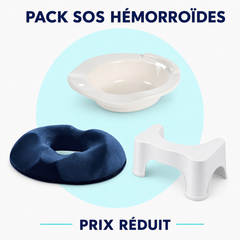
This is the most frequent reason among our customers. Sitting becomes uncomfortable, the anal area is sensitive, and local cooling is one of the very first things that comes to mind. The cold sitz bath is the classic of the genre; the gel pack reinterprets the idea in a mobile form, usable at the office or in front of the television. Many alternate between the two depending on the time of day.
Heavy legs at the end of the day
Prolonged standing, summer heat, long hours sitting: the sensation of heavy legs affects millions of people, and it is one of the primary reasons for researching the derivative bath. Practitioners describe a session in the late afternoon, often combined with lying down with legs elevated for twenty minutes.
Menstrual pain
Some women use perineal cooling during their period, when the sensation of heaviness in the lower abdomen dominates. Others, on the contrary, prefer heat. Both approaches coexist, and the reversible pack allows exactly for that choice. Be careful, however: in case of heavy periods, the practice of cold is to be avoided (see the "Precautions" section below).
Postpartum
The postpartum period is when the perineum requires the most attention. Local cooling is a comfort measure widely known to new mothers and commonly advised in the first few weeks by midwives in various forms. Here again, the advice of the professional providing the follow-up takes precedence: after an episiotomy, a tear, or a cesarean section, wait for their green light.
From Louis Kuhne to the gel pack
The practice is nothing new. It spans a century and a half and three successive forms of equipment.
Louis Kuhne, 19th century
We owe the codification of the method to the German Louis Kuhne (1835-1901). In his works, now in the public domain, he describes a particular sitz bath: you sit in a basin of cool water, with your legs and torso remaining out of the water, and perform a gentle friction of the perineum using a cloth. The protocol is precise, the duration is graded, and the area concerned is exactly the one targeted by today's packs. Kuhne is the historical reference for the derivative bath.
Raymond Dextreit and the French transmission
In France, the naturopath Raymond Dextreit (1908-2001) resumed and popularized the method in an abundant production of natural health books in the mid-20th century. It is through him that the derivative bath entered the French-speaking hygienist vocabulary to stay, alongside clay, plants, and nutrition.
The general public of the 1980s
The practice left the circle of insiders when singer Rika Zaraï introduced it to the general public in her natural health books, which were huge bestsellers at the time. A whole generation then discovered the cold sitz bath at home — and a good portion of the people who write to us today heard about it back then, from their mother or grandmother.
The gel pack, modern form
The obstacle has always been the same: sitting in cold water immobilizes you for half an hour, on the toilet or in front of a basin, and discourages consistency. The gel pack removes this constraint. Cooled in the freezer and slipped into your underwear against a protective towel, it releases its coolness for a long time without immobilizing anything. Kuhne's method loses its friction, but gains what matters most in a daily practice: the ease of repeating it every day.
How to practice the derivative bath
The action is simple, but three points are non-negotiable: the protective towel, the ramp-up time, and suitable underwear.
Preparing the pack
Place the gel pack in the freezer for 1 to 2 hours. There is no need to leave it in overnight: it must remain flexible to conform to the area, not become a rigid block. If it comes out too hard, let it rest for a few minutes at room temperature before using it.
The protective towel: always
⚠️ The pack should never be placed directly on the skin. A protective towel must always be placed between the gel and the perineum. Direct contact with a gel pack taken out of the freezer exposes you to cold burns on particularly thin skin. This is the number one rule of the practice, which is why our kits come with their textile protections rather than just the packs.
Positioning correctly
The protected pack is slipped into standard briefs or panties, which keep it pressed against the perineum. Thongs are not suitable: they do not hold anything in place. Cotton underwear of the right size, neither too loose nor too tight, provides the best support. With loose pants on top, the session becomes completely invisible.
How long
Start with 20 to 30 minutes in the evening, over a few days, to get used to the sensation. Then increase gradually according to your comfort. A pack retains its coolness for up to 2 hours; beyond that, it becomes lukewarm and must be put back in the cold.
- First week: 20 to 30 minutes per day, preferably in the evening, in quiet.
- Afterwards: increase in stages, one pack at a time, to the duration that suits you.
- In rotation: with the 3 packs in the kit, one in contact while the other two are cooling, the practice can cover several hours a day.
- Time to avoid: digesting a heavy meal. Wait 2 hours after finishing your meal.
Consistency matters more than duration. Twenty minutes every evening is better than two hours once a week. For the step-by-step procedure, our derivative bath user manual details every step with images.
Day, night
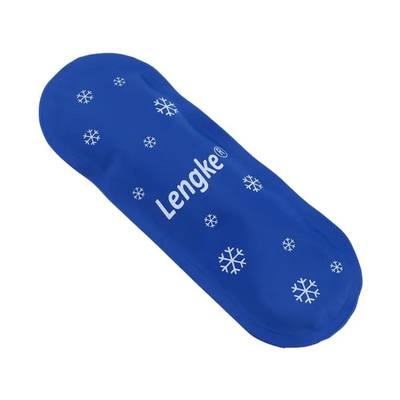
Two formats cater to two different uses. The daytime pack measures 17.5 × 6.5 cm: a narrow format, designed to be forgotten under clothing while moving around, and which stays cool for up to 2 hours.
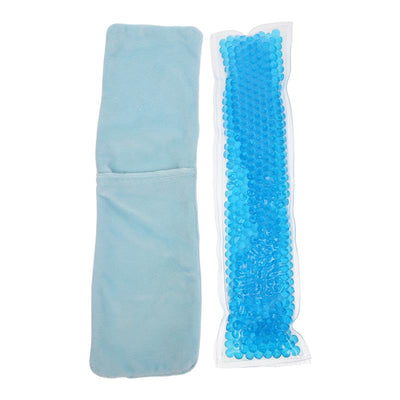
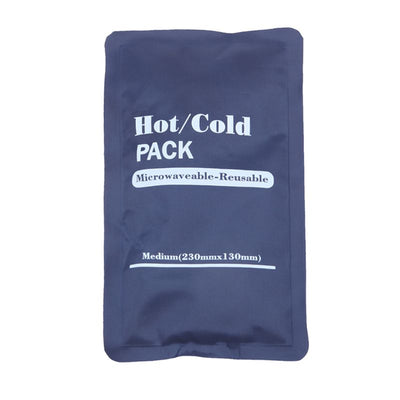
The reversible hot/cold night pack measures 23 × 13 cm. Its larger surface covers more area while lying down and requires no adjustment during sleep. Its reversible side allows you to switch to heat on days when coolness is not welcome — during your period, in the cold season, or simply as a preference of the moment.
Maintaining the equipment
The protective towels are machine washable at 30 °C. Have enough to rotate: a clean one for every session is the basis of hygiene for the practice. The gel packs should be rinsed with lukewarm water and dried before going back into the freezer. Store them flat, without sharp objects nearby. Finally, a word on the location: the pack is prepared and stored in the kitchen, and put in place in the toilet or bedroom — no complicated handling to foresee.
Precautions and contraindications
Applying cold locally requires some safeguards. This list is the one we pass on to all our customers, and it is worth reading before the first session.
- Pregnancy: the practice should be avoided throughout the duration of pregnancy.
- Heavy periods: pause the practice of cold during those days.
- Post-surgery: wait for explicit approval from your doctor, especially after surgery on the perineal, anal, or abdominal area.
- Cardiac or circulatory disorders: ask for the advice of a health professional before starting.
- Local loss of sensitivity: without normal perception of cold, the warning signal that tells you to remove the pack no longer exists. The practice is not recommended.
- Raynaud's syndrome: exposure to cold should be avoided.
- Ongoing urinary infection: postpone sessions and consult a doctor.
- After a heavy meal: let 2 hours pass before applying the pack.
Furthermore, three reflexes regardless of your profile: never place the gel directly on the skin, remove the pack immediately if any pain, numbness, or marked redness appears, and never prolong a session that becomes unpleasant. Comfort is the only valid indicator.
Which equipment to choose
Two options cover the essential needs, depending on whether you are a beginner or already practicing.
To start: the complete kit
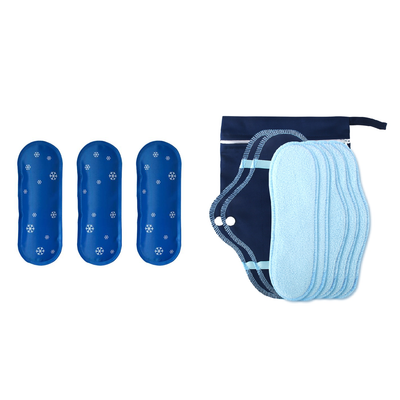
The Derivative Bath Kit brings together everything you need to practice from the very first evening, for €49.90:
- 3 gel packs, to keep up the rotation and do back-to-back sessions without waiting.
- 2 washable protective towels, the essential piece between the gel and the skin.
- 5 microfiber protection bands, to renew the contact layer.
- 1 transport cover, which allows you to carry a pack to work or while traveling.
This is the option that the vast majority of our customers choose, and the only one that includes the textile protections immediately.
To renew: the set of 3 packs
If you already have the towels, the set of 3 gel packs only, at €29.90, allows you to expand your rotation or replace worn-out packs. The more packs you have in the freezer, the easier it is to maintain long sessions. If you are still hesitant about the handling, our guide on using a derivative bath pack answers the most common questions before buying.
Frequently asked questions
How long should I keep a derivative bath pack on?
Start with 20 to 30 minutes in the evening for the first few days, then increase gradually according to your comfort. A pack retains its coolness for up to 2 hours before it becomes lukewarm.
With the 3 packs of the kit in rotation — one in contact, two in the freezer — the practice can extend over several hours during the day. Remove the pack as soon as any unpleasant sensation appears.
Can I place the gel pack directly on the skin?
No, never. A protective towel must systematically be placed between the pack taken out of the freezer and the perineum. Direct contact exposes you to cold burns on very thin skin.
It is for this reason that the Derivative Bath Kit contains 2 washable towels and 5 microfiber bands in addition to the 3 gel packs. The towels are machine washable at 30 °C.
Who should not practice the derivative bath?
Perineal cooling should be avoided during pregnancy, in case of heavy periods, cardiac or circulatory disorders, Raynaud's syndrome, local loss of sensitivity, or an ongoing urinary infection.
After surgery, medical approval is necessary before resuming. Also wait 2 hours after a heavy meal. In case of doubt about your situation, ask for the advice of a health professional before starting.
The derivative bath is a well-being practice: it does not replace medical advice or treatment.