

Physiological toilet stool and constipation: the right position
Do you spend long minutes in the bathroom with no results? The problem is sometimes less about your diet and more about your position. Here is why, and how to fix it with a simple stool.
Why the sitting position makes going to the bathroom more difficult
For millennia, humans squatted to have a bowel movement. Modern toilets, which arrived just over a century ago, have made us adopt a sitting position that is much more comfortable for the back... but less natural for the intestine.

The angle that makes all the difference
A strap-like muscle, the puborectalis muscle, surrounds the rectum and keeps it slightly bent: it is what ensures continence on a daily basis. In the standard sitting position, it remains partially contracted and maintains this curvature.
When the knees are raised above the hips, as in a squatting position, this muscle relaxes and the angle opens. Passing stool is then more direct, with less straining effort. This is exactly what a physiological stool reproduces: a few centimeters under your feet are enough to regain this position, without changing anything about your toilet.
Less straining, more comfort
It is mainly the effort of straining that most users notice decreasing first. Yet it is precisely this repeated effort that makes trips to the bathroom difficult and tires out the perineal area.
- A simpler motion: the position does some of the work, so you strain less.
- Less time sitting: many users significantly shorten their time in the bathroom.
- Real daily comfort: particularly appreciated after childbirth or in case of sensitivity in the area.
- Nothing to install: the stool slides in front of the toilet bowl, is removed, and can be cleaned in seconds.
It is a comfort aid, not a treatment: if constipation persists or is accompanied by pain or bleeding, speak to your doctor.
How to use it daily

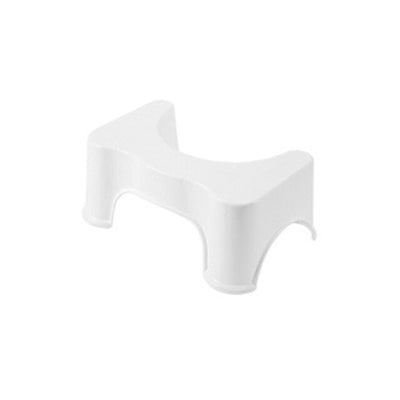
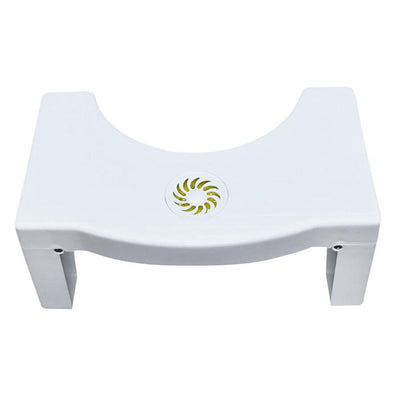
- Slide the stool against the toilet bowl, with the cutout fitting its shape.
- Sit down normally, then place both feet flat on the stool.
- Check that your knees are raised above the level of your hips.
- Lean slightly forward, elbows on your thighs, and relax your stomach.
- Let nature take its course, without forcing. That is the whole point of the position.
In the first few days, the feeling might be surprising: that is normal, as your body has become used to the other posture. Give yourself about a week before judging.
Which model to choose
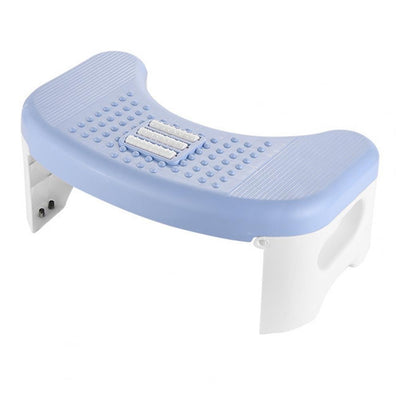
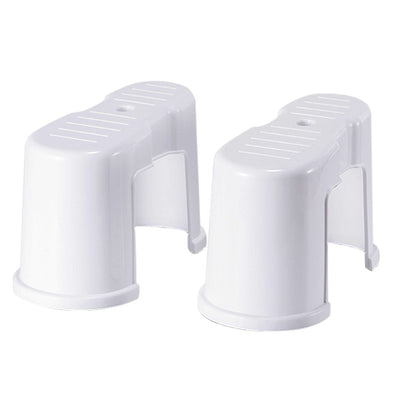
Three criteria really count. Height first: it must be enough to raise your knees without throwing you off balance. The shape next: a well-designed cutout allows the stool to be stored under the toilet bowl without getting in anyone's way. Stability finally: non-slip pads and rigid plastic, because it supports your full weight.
Our Physiological Toilet Stool combines all three: easy-to-clean rigid plastic, a cutout shape that slides under the toilet between uses, and a non-slip surface. It comes in several colors to blend into the room.
The stool is one of the three most common accessories found among people prone to hemorrhoids, along with the sitz bath basin and the seat cushion.
Discover the physiological stoolTo learn more, we detail the posture step-by-step in our article on the proper position on the toilet, and all of its uses in physiological stool: the many benefits.
Frequently Asked Questions
What height of physiological stool should I choose?
The right guide is not a number in centimeters, but your body type: once your feet are placed, your knees should be higher than your hips. A height of around 20 cm is suitable for the vast majority of adults and standard toilets.
A stool that is too high would throw you off balance, and one that is too low would not change the position much. When in doubt, it is better to stick to a standard model designed for classic toilet bowls.
How long does it take to feel the difference?
The position is noticeable from the very first use, but it often takes a few days for it to feel natural. The essential thing is to use it every time: consistency is what counts, not intensity.
If constipation persists despite good hydration, a diet rich in fiber, and this position, consult a healthcare professional: the stool is a comfort aid, it does not replace medical advice.
Can I use it after childbirth?
This is one of the times it is most appreciated, precisely because it allows you to strain less during a period when the perineal area is sensitive. Many new mothers adopt it as soon as they return home.
As with any procedure or in case of special follow-up, ask your midwife or doctor, who is familiar with your situation, for confirmation.
Does the stool take up space in the bathroom?
No, that is precisely the benefit of the cutout shape: between uses, the stool slides under the toilet bowl and disappears almost entirely. Even in narrow bathrooms, it does not obstruct the way.
A wipe with a soapy sponge from time to time is enough to maintain it, as the rigid plastic is moisture-resistant.