

Non-electric Japanese toilet: which kit should I choose?
Most French toilets do not have a power outlet. This is the first obstacle when dreaming of a Japanese toilet — and it is precisely what non-electric kits solve, as they can be installed in minutes without any renovation work.
Is a Japanese toilet without a power outlet possible?
Yes, and it is actually the most common solution in France. A non-electric Japanese toilet kit attaches under your existing toilet seat and connects to the toilet's water supply. No electrical connections, no batteries: it uses the mains water pressure to power the nozzle.

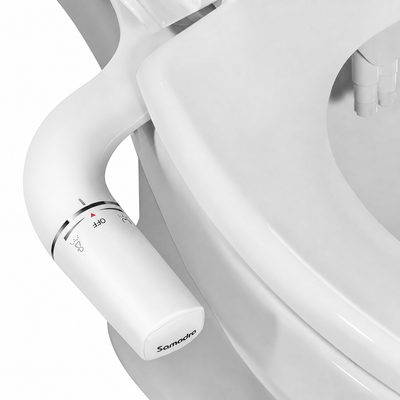
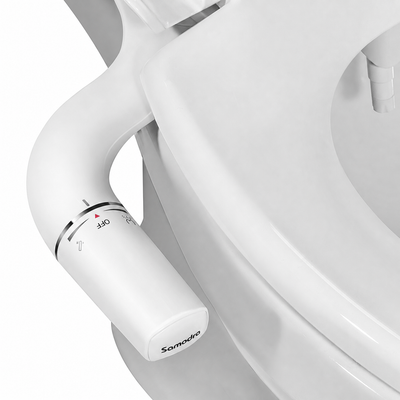
You turn the dial one way or the other, the spray activates, and you adjust the pressure to your liking. Once closed, the kit is discreet: it is only 6 mm thick, making it almost invisible.
The practical benefits for you
- No renovation required: no need for an electrician, a plumber, or to install a power outlet in a room that lacks one.
- Zero power consumption: nothing heats up, nothing stays on standby, so your electricity bill remains unchanged.
- Nothing to replace: no electronic boards or heating elements, so there is no risk of electronic failure.
- Budget-friendly: expect to pay around €60 to get equipped, compared to several hundred euros for an electric seat.
- Removable: if you are renting, you can take it with you when you leave by simply putting the original seat back on.
The trade-off to consider before buying: without electricity, the water arrives at mains temperature. In winter, it is cool. Many people get used to this just fine; others prefer a model that can be connected to the hot water supply: we cover that below.
Which kit to choose based on your needs
Three models cover most situations, from the simplest to the most comprehensive.
To get started without mistakes
The Non-Electric Japanese Toilet Kit is the entry point: two washing modes (rear and feminine), adjustable pressure, stainless steel nozzles, braided steel hose, and brass adapter. This is the model we recommend for a first-time purchase: at around €60, it does everything you would expect from a Japanese toilet on a daily basis.
For daily family use
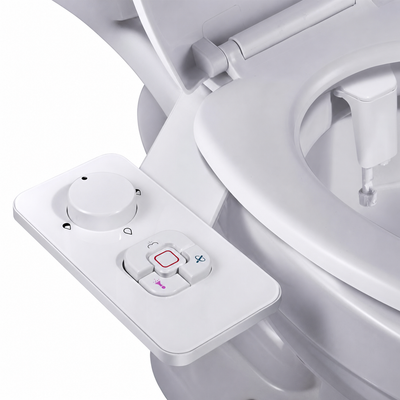
The Classic Japanese Toilet Kit adds a third mode: self-cleaning nozzles before and after each use. A detail that matters when several people share the same toilet. It is available in four colors to match your bathroom decor.
For hot water
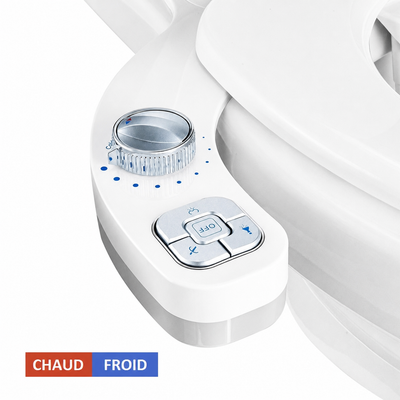
The Deluxe Japanese Toilet Kit connects to both cold and hot water, with a mixer to adjust the temperature. It remains entirely mechanical, and therefore still requires no electricity: the only condition is having an accessible hot water supply near the toilet, which is the case when the toilet is adjacent to a bathroom.
| Criterion | Non-Electric | Classic | Deluxe |
| Washing modes | 2 (rear, feminine) | 3 (inc. self-cleaning) | 2 modes + mixer |
| Water temperature | Mains water | Mains water | Adjustable, hot and cold |
| Electricity | None | None | None |
| Colors | White | 4 colors | White |
| Indicative price | around €60 | around €96 | around €120 |
Up-to-date pricing is always shown on the product pages. The entire range can be found in the Japanese Toilet Kit collection.
Free delivery in France, and free parcel tracking on orders over €60.
See the non-electric kitCheck compatibility, then install
Two measurements to take before ordering
Our kits fit 99% of standard toilet bowls, but two minutes of verification will save you any unpleasant surprises. Grab a tape measure:
- The distance between the seat mounting holes must be between 8 and 21 cm.
- The distance between the back edge of the bowl and the wall must be at least 10 cm to accommodate the connection.
Also, check that the water supply valve for your toilet tank is accessible: this is where the included T-adapter will be placed.
Installation, step by step
- Turn off the water supply valve and flush the toilet to empty the tank.
- Remove the existing toilet seat by unscrewing its two mountings.
- Place the kit on the bowl, put the seat back on top, and tighten.
- Screw the T-adapter onto the water inlet, using the provided sealing tape.
- Connect the braided hose between the adapter and the kit, turn the water back on, and check that no connections are dripping.
Expect about fifteen minutes for the first time, less if you have already changed a toilet seat before. All the necessary materials are in the box, and our illustrated installation guide covers each step on video. We also detail the installation of an electric model in installing a Japanese toilet seat in 5 steps.
Frequently Asked Questions
Is cold water really bearable?
That is the question everyone asks. The water arrives at mains temperature, which is cool rather than icy, and the spray lasts only a few seconds. The vast majority of users get used to it within two or three days, and some even appreciate the invigorating effect.
If you already know that cold water will bother you, look directly at the model that connects to hot water: that is the only criterion that truly justifies doubling the budget.
Do I need a plumber to install it?
No. The process involves unscrewing the seat, placing the kit underneath, and inserting an adapter onto the existing water inlet. No cutting, no drilling, no welding: everything screws on by hand or with pliers.
The kit contains the hose, the T-adapter, the mounting plates, the washer, and the sealing tape. You do not need to buy anything extra.
Can I install it in a rental property?
Yes, that is one of the great advantages of these kits: nothing is permanently modified. You keep the original seat and put it back in place on the day you move out, taking your kit with you.
Disassembly takes about the same amount of time as installation, about ten minutes.
How is it different from a hand-held toilet sprayer?
The hand-held sprayer is held and directed by yourself; the Japanese kit has fixed nozzles that deploy under the bowl and are controlled by a dial, without having to bend over or hold anything.
This makes it particularly convenient for people with reduced mobility or those in the later stages of pregnancy. We compare the two solutions in sprayer vs. Japanese toilet.
Is the kit resistant to water pressure?
That is precisely where the difference lies between a reliable kit and a low-end model. Ours use a brass adapter and a braided steel hose, whereas cheaper kits settle for plastic.
These two parts prevent leaks over the long term on a connection that remains constantly under pressure.