

How do Japanese toilets work? Advantages of washlet toilets
This article explains in detail how a Japanese toilet works and shows how these devices improve daily hygiene, without electricity or complications. You will discover the principle of the Japanese toilet, the different washing modes, and how to easily install this system on your current toilet.
We will also see how the Japanese toilet reduces your paper consumption while offering much more effective cleaning.
But perhaps you first want to know what a Japanese toilet is?
How does a Japanese toilet work without electricity?
A non-electric Japanese toilet kit works solely thanks to the natural pressure of the domestic water supply. No electrical outlet, battery, or electronic component is needed to activate the sprays: this entirely mechanical system is extremely reliable and requires very little maintenance.

The mechanical principle of the wash spray
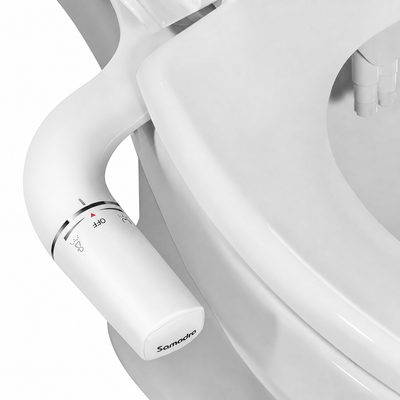
The principle of the Japanese toilet is based on a mechanism as simple as it is ingenious. Water arrives via a brass T-adapter, connected directly to your cold water supply. A conduit then routes it to the spray nozzles located under the ultra-thin seat.
As soon as you activate the side button, dial, or control, a mechanical valve opens and directs the flow toward the nozzles. No motor, pump, or electronic component is involved.
- Direct water supply: the brass adapter connects to your existing plumbing, without any plumbing work.
- Mechanical valve: the manual control operates a valve that directs the spray forward or backward, depending on your choice.
- Precise positioning: the nozzles are placed for effective cleaning, without splashing.
The mains pressure is more than sufficient to produce a powerful and adjustable spray. This design eliminates any risk of electrical failure. In summary, how does a Japanese toilet work? Water, pressure, and a manual valve.
Quick installation on existing toilets
Installing a Japanese wash toilet takes less than 5 minutes and requires no drilling or special tools. With a thickness of only 6 mm, the ultra-thin seat fits 99% of standard bowls, whether wall-hung or floor-mounted. Three steps are enough: remove the old seat, attach the kit, and connect the braided hose to the water supply.
The kit includes everything necessary: T-adapter, hose, seals, and shut-off valve. To enjoy hot water, a second connection to the domestic supply allows you to adjust the temperature. This non-electric system is perfect for older homes, rentals, or any space without a nearby outlet.
What are the different washing modes?
Modern Japanese toilets offer several cleaning modes. Our Japanese toilet kits install directly onto a standard seat and include up to three washing functions depending on the model.

Front and rear sprays, for targeted cleaning
The rear spray is designed for anal cleaning, while the front spray is specifically designed for feminine intimate hygiene.
The rear mode cleans the posterior area with a spray positioned about 15 centimeters from the seat. The feminine mode projects water forward—especially appreciated during menstruation or pregnancy.
- Rear mode: precise cleaning thanks to an angled spray, suitable for both men and women.
- Front mode: a gentle wash, designed for female anatomy.
- Self-cleaning mode: it automatically rinses the nozzles after each use, which limits limescale buildup.
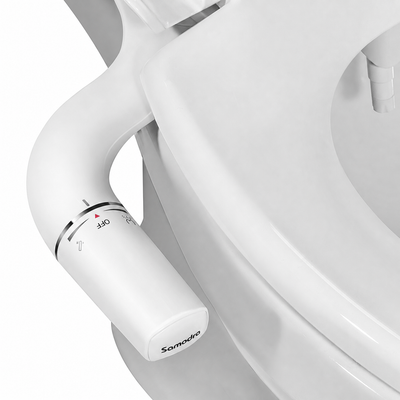
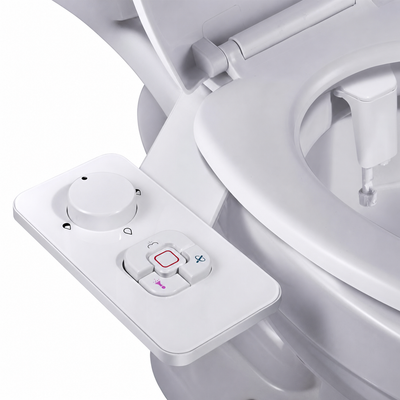
Choosing the mode is very simple: a side dial or button. This mechanical control works without electricity, under all circumstances.
Each Japanese toilet adapts to the user's sensitivity. People prone to hemorrhoids particularly appreciate the gentleness of the spray—it is even the number one reason they equip themselves.
Pressure adjustment
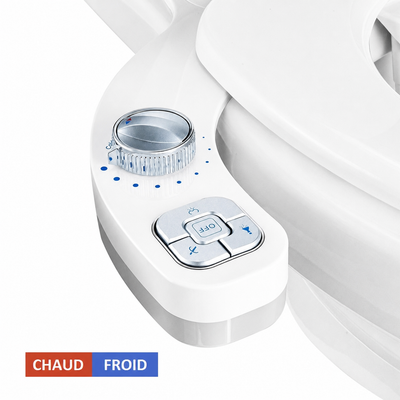
The Japanese toilet allows you to precisely adjust the pressure via a rotating dial. You modulate the flow, from the gentlest to the most vigorous.
Adjustment is done by turning the knob, with clear visual markers. A light pressure is suitable for sensitive skin, while a more intense spray is for faster cleaning.
- Gentle pressure: about 30% of maximum flow, perfect for delicate intimate hygiene or for children.
- Medium pressure: around 50%, the standard setting that suits most users.
- Strong pressure: about 70% of maximum power, for a vigorous clean.
This modulation also helps optimize consumption: everyone chooses the flow they really need.
Self-retracting telescopic nozzles
The nozzles deploy automatically upon activation and fully retract once rinsing is finished. This mechanism reduces deposits and water stagnation, which extends the device's lifespan.
The antibacterial coating of the nozzles also limits the proliferation of microbes. A durable design that requires minimal maintenance.
How to adjust the spray temperature?
Adjusting the water temperature is crucial for comfort, especially in winter. Most models allow you to adjust the hot water temperature, generally between 30 and 45°C. This manual, simple, and intuitive control changes everything depending on the season.

Hot and cold water connection
Installing your Japanese wash toilet seat begins with a connection to the cold water supply using the included adapter. For hot water, a second connection is required. This dual-feed system allows the flows to be mixed to reach the ideal temperature.
If you choose not to connect hot water, the device works perfectly with cold water—pleasant all year round, and frankly refreshing in summer. Sturdy hoses and quality seals ensure a durable and leak-proof installation. Built-in thermal protection also limits the maximum temperature, eliminating any risk of burns.
Hygiene and comfort of use
The main advantages of a Japanese toilet are comfort and cleanliness. Washing with water is much gentler and more complete than using paper alone. It is the ideal method to improve your intimate hygiene and soothe irritated skin.
- Superior cleaning: water removes residue without damaging the skin.
- Adapted to sensitive areas: this is the gesture most often recommended for hemorrhoids, pregnancy, or menstruation.
- Personalized comfort: pressure and temperature are adjustable with each use.
Users describe immediate freshness and a feeling of cleanliness that lasts. No more chronic irritation caused by the repeated friction of paper.
Savings and ecological impact
The water consumption of a Japanese toilet is very modest—about half a liter per use—compared to the savings made on paper: 70 to 90% less, or nearly €90 per person per year. For comparison, the manufacture of a single roll of paper consumes 140 liters of water.
The ecological impact is therefore significantly reduced: less waste and a lighter carbon footprint on paper production and transport. Moreover, the mechanical operation consumes zero electricity.
| Criteria | With a Japanese toilet | Toilet paper only |
| Rolls per year per person | 10 to 30 | about 100 |
| Water consumed per wash | about 0.5 liters | 140 liters per roll manufactured |
| Electricity | None (mechanical model) | None |
| Annual savings | €90 per person (€360 for 4) | €0 |
Savings accumulate quickly and pay off the initial cost in a few months. If you completely replace disposable paper with washable toilet wipes, they are even more significant.

Accessibility for people with reduced mobility
The Japanese wash toilet is an ideal solution for seniors and people with reduced mobility: it eliminates the difficulty of manual wiping and restores true autonomy. A precious peace of mind, for both users and their caregivers.
How to maintain your Japanese toilet?
Daily maintenance is remarkably simple. A well-maintained system works perfectly for many years.
Self-cleaning of the nozzles
Each use triggers an automatic rinsing of the nozzles: as soon as the spray stops, a small volume of pressurized water removes any residue.
- Automatic rinsing: it eliminates impurities and extends the lifespan of the nozzles, without the slightest effort.
- Hygienic protection: stainless steel and ABS limit the development of microbes between uses.
Once rinsed, the nozzles retract, protected from dirt. No manual intervention is necessary.
Manual maintenance and descaling
Light and occasional maintenance is enough: a soft, damp cloth on the joints and visible parts. In case of limescale buildup, shut off the water and rinse the nozzles after removing them.
- Weekly cleaning: a simple wipe of the fittings with a cloth.
- Annual descaling: recommended once a year if your water is hard.
- Easy replacement: the modular design allows for very simple replacement of seals and hoses.
The installation of a sediment filter on the water supply blocks particles and protects the internal mechanism. With materials like brass, your installation will perfectly resist humidity.

Frequently Asked Questions
How do Japanese toilets work without electricity?
Their operation relies solely on the natural pressure of the mains water. A T-adapter connects to the cold or hot water supply to feed the nozzles via a dedicated conduit.
When you activate the button or dial, a valve opens and releases water toward the nozzles—without any source of electricity. This purely mechanical system works even during a power outage.
Are Japanese toilets really more hygienic?
Yes, without hesitation: the level of hygiene is far superior to that of toilet paper. Washing with water is, in fact, the gesture most commonly advised for people prone to hemorrhoids or irritation.
Furthermore, the nozzles are self-cleaning, which guarantees their cleanliness at each pass. Discover our article Japanese toilet: a revolutionary concept for perfect hygiene.
What is the water flow rate, and how can I reduce consumption?
On average, a Japanese toilet consumes about half a liter of water per use, depending on the spray duration and chosen pressure. The adjustment dial allows you to moderate the flow without losing any efficiency.
This consumption remains negligible compared to the savings made on toilet paper—and compared to the 140 liters of water required to manufacture a single roll.
Japanese toilet kit vs. seat: what is the difference?
A Japanese toilet seat is an upgraded kit featuring an integrated seat. They come in various shapes to fit different bowls: round (O), elongated (D), or V-shaped. The washing principle is exactly the same as with a kit—with the added convenience of the seat.
Some electric toilet seats add advanced features: heated seat, warm air drying, proximity sensors, and night lighting.
Japanese toilet or bidet sprayer: which to choose?
Unlike the Japanese toilet, the bidet sprayer does not attach to the bowl, but to the tank or directly to the wall. You hold it and direct it yourself toward the area to be cleaned by pressing a trigger.
Both systems are effective, operate without electricity, and require no construction work. The difference mainly comes down to personal preference: some appreciate the maneuverability of the sprayer, while others prefer the simplicity of the Japanese toilet, which is operated via a dial without having to lean over.
Full Japanese toilet or DIY kit?
A full Japanese toilet is a complete unit that integrates the bowl, the tank, and the washing system. It is suitable for new construction or full renovations—at a very high installation cost, especially with the options.
These high-tech toilets, very common in Japan, combine ergonomic design with multiple functions: proximity sensors, automatic flush, heated seat, air drying, deodorization, and wireless remote control. Our electric Japanese toilet seats offer the same benefits at a much more affordable price.
Our non-electric DIY kits do not have all these features, but they transform a standard bowl into a washlet at a low cost. They are the ideal option for small spaces, tight budgets, renters—and anyone who prefers a reliable, non-electronic system.

Having trouble making your choice? Check out our Japanese toilet model comparison.