

Sitz bath for hemorrhoids: a technique for effective relief
A sitz bath is the oldest and simplest way to soothe a hemorrhoidal flare-up. When done correctly, it provides relief in just a few minutes without having to swallow anything. Everything depends on two parameters: the water temperature and the duration of immersion.
This article details the exact protocol—cold during a flare-up, lukewarm otherwise—the additives that are worth using, and the mistakes that turn a soothing treatment into a source of additional irritation.
The cold-water sitz bath during a flare-up
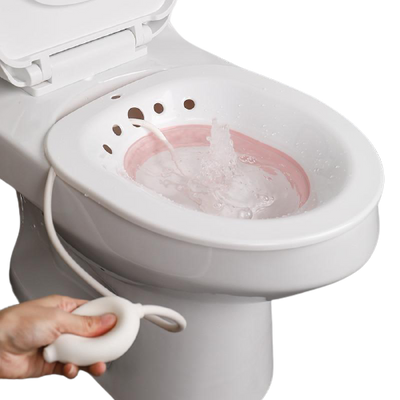
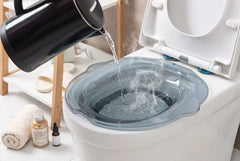
This is the emergency measure. Immersing the perineum in water between 10 and 20 °C (50–68 °F) causes immediate vasoconstriction: the dilated vessels shrink, and the burning sensation subsides. A basin placed on the toilet seat is sufficient—there is no need to fill a bathtub.

Why cold instead of hot
This is the point everyone gets backward. During a hemorrhoidal flare-up, heat dilates the vessels and worsens congestion: it may provide temporary relief, but then makes things worse. Cold does the opposite.
- Vasoconstriction: cold tightens the venous network and reduces swelling in the area.
- Anesthetic effect: it’s the same principle as an ice pack on a sprain—the painful sensation fades in a few minutes.
- Venous return: alternating temperatures is traditionally used to stimulate local circulation, which is the source of the congestion.
A tip that makes all the difference: keep your upper body covered during the session. It is the contrast between a warm body and a cold area that produces the desired effect—not the cold alone.
The technique, step by step
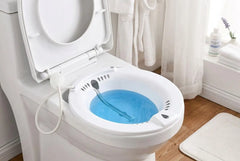
Placing the basin directly on the toilet stabilizes the pelvis and avoids any contortion. Always test the temperature with your wrist before sitting down.
- Filling: 5 to 10 cm (2 to 4 inches) of water is enough—the area must be immersed, nothing more.
- Position: sit with a stool under your feet to relax the pelvic floor.
- Covering: a warm garment over your shoulders to maintain your body heat.
- Duration: breathe calmly for 10 to 15 minutes, without exceeding 20 minutes.
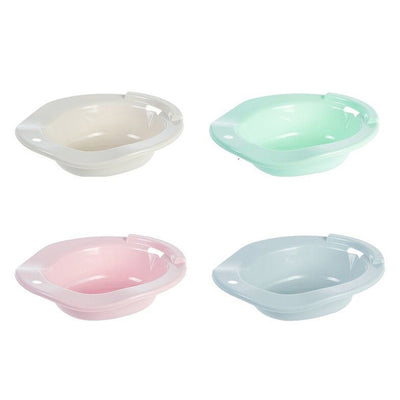
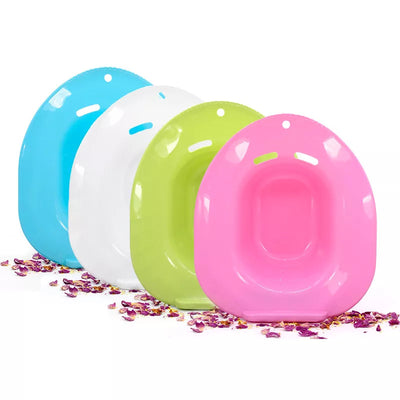
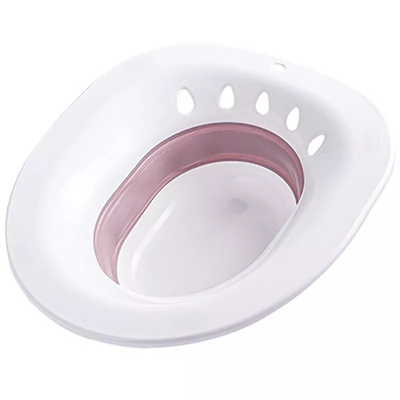
A sitz bath basin offers the best ergonomics: it fits 99% of standard toilet seats, and its drainage nozzles prevent any overflow when you sit down.
That is also its main advantage over a fixed bidet. The basin is personal: you rinse it, dry it, and put it away after each use. A ceramic bidet, on the other hand, remains in place, damp, and is shared by all occupants of the home—not to mention the floor space it occupies and the plumbing work it requires. For such an intimate use, and especially on an irritated area, the difference is significant.
Browse the entire range of sitz bath basins, from the simplest model to one equipped with a rinsing bulb.
Frequency and duration
During an inflammatory period, aim for 2 to 3 baths per day, ideally after each bowel movement. Do not do more: the skin will eventually macerate and become fragile, which produces the exact opposite of the desired effect.
Bathing after a bowel movement has a dual benefit: it soothes and cleanses the area without any rubbing. During remission, switch back to lukewarm water, 37–38 °C (98.6–100.4 °F), for 10 to 15 minutes, to relax the sphincter.
What additives should be added to the water?
Additives are not strictly necessary—water alone works very well. But some are traditionally used either to sanitize or to soothe. The principle remains the same: use sparingly, dissolve well, and never use on an open lesion.

The steps, in order
A basin placed on the toilet is much more suitable than a bathtub: the water—and the additives—remain concentrated on the area instead of being diluted in 100 liters.
- Prior cleaning: rinse the basin before each session and clean it with soapy water afterward. Dry it completely.
- Filling: 5 to 10 cm of water at the right temperature. Completely dissolve the additives before you sit down—an undissolved grain can become abrasive on raw skin.
- Installation: place the basin firmly on the toilet bowl, with the seat raised. A stool under your feet relaxes the pelvic floor.
- Duration: 10 to 15 minutes, 20 maximum. Neither shorter—the effect doesn't have time to take hold—nor longer.
What is worth adding
In an acute crisis, simplicity wins: cold water, and possibly a handful of coarse salt. More elaborate preparations are best reserved for when you are not having a flare-up.
| Additive | Traditional use | Quantity | When |
| Coarse salt or sea salt | Known to be sanitizing and soothing | ¼ cup | Any situation, including flare-ups |
| Epsom salt | Traditionally used for a sensation of swelling | ¼ to ½ cup | Outside of flare-ups, feeling of tension |
| Baking soda | Known to soothe itching | 1 tbsp per liter | Itching |
| Witch hazel (infusion or floral water) | The astringent plant most associated with venous comfort | 2 tbsp | External hemorrhoids, no lesions |
| Essential oils (lavender, cypress) | Known to be soothing—never pour neat | 3 to 5 drops, pre-diluted | Only outside of flare-ups |
An absolute rule about essential oils: they do not dilute in water. If poured directly, they float as pure droplets and burn the mucous membrane. You must mix them first with a dispersing agent—bath base, milk, honey, or a spoonful of vegetable oil. In the middle of a flare-up, with an area already raw, it is better to skip them entirely.
After the bath, and precautions
Dry the area by patting with a clean towel—never by rubbing. Rubbing is exactly what turns a soothing treatment into a source of irritation.
For cleaning after each bowel movement, a portable bidet or a toilet sprayer is a better alternative to toilet paper: water removes residue without any contact.
Consult a doctor without delay if bleeding persists, if the pain intensifies rapidly, or if a hard lump appears—a thrombosed hemorrhoid requires medical care. The sitz bath is a comfort treatment: it provides support, it does not diagnose anything.
For more information, see our articles on positions that relieve and on the choice between hot and cold water.
Frequently Asked Questions
What is the recipe for an effective sitz bath for hemorrhoids?
The simplest is the best: cold water between 10 and 20 °C, and possibly a quarter cup of coarse salt well dissolved. Nothing else is necessary during a flare-up.
Outside of a flare-up, you can add baking soda for itching or a witch hazel infusion. Essential oils must always be diluted in a dispersing agent beforehand—never poured pure into the water.
How long and how often should a sitz bath be taken?
10 to 15 minutes per session, 20 maximum, 2 to 3 times per day—ideally after each bowel movement. This is the guideline for both during and outside of flare-ups.
Any longer, and the skin macerates and becomes fragile: you would achieve the opposite of the desired effect. Three short baths are better than one endless one.
Basin or fixed bidet: which to choose?
The basin, without hesitation—especially for a sitz bath. It sits on the toilet bowl, requires no installation work, takes up no floor space, and remains personal: you rinse it, dry it, and put it away.
A fixed bidet requires a water supply, a drain, and a plumber. It remains in place, damp, and is shared by everyone in the home. For a few liters of water two or three times a day, the basin is infinitely more practical.
Cold or hot water: which to choose?
Cold during a flare-up (10 to 20 °C): it tightens dilated vessels and soothes burning. It is the traditional reflex and the most effective in the acute phase.
Lukewarm outside of a flare-up (37–38 °C): it relaxes the sphincter and supports circulation. Conversely, avoid hot water during a flare-up—it dilates the vessels and worsens congestion.
The sitz bath is a practice for hygiene and comfort. It does not replace a diagnosis or a prescribed treatment: in case of bleeding, intense pain, or persistent symptoms, consult a doctor.