

Which bidet sprayer to choose? A guide to the best options
Choosing the right bidet sprayer is essential for intimate hygiene tailored to your needs. This comparative guide helps you decide between three options: the economical plastic model, the durable stainless steel version, and the thermostatic option for maximum comfort. Includes our buying tips at the end.
Which type of bidet sprayer for your toilet?
A bidet sprayer is installed next to your toilet for targeted cleaning after each use. Unlike a classic shower head, it is equipment designed for intimate hygiene — practical and economical for the whole family.

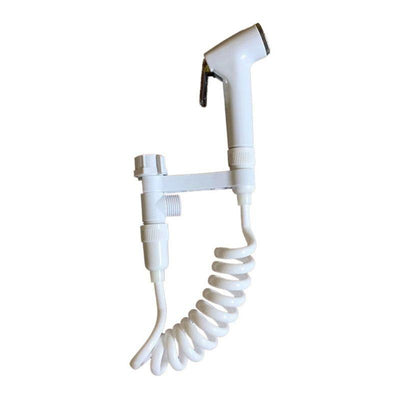
ABS plastic: economical and lightweight
If you are looking for a simple and functional solution, ABS plastic is the most affordable choice. Lightweight and easy to install, it is perfectly suited for tight budgets, temporary installations, and small spaces.
- Lightweight and simple installation: its low weight allows for quick mounting without specialized tools or major drilling.
- Resistance: ABS absorbs minor impacts and does not rust, making it ideal for humid environments.
- Easy cleaning: a simple rinse with clean water is enough for daily maintenance.
- Highly competitive price: it is the most economical option for switching to water-based hygiene.

To maintain performance, an occasional descaling of the head with white vinegar is enough to remove limescale.
Stainless steel: the long-term choice for intensive use
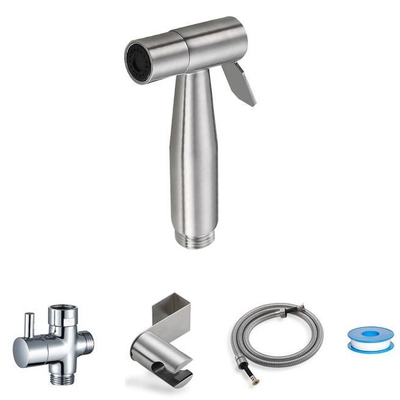
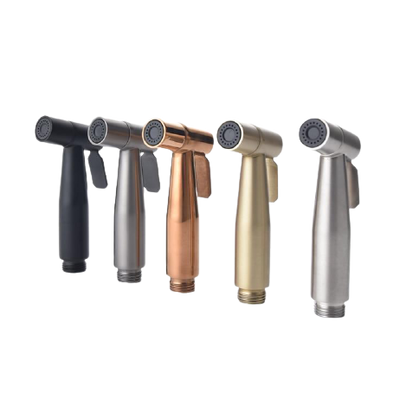
Stainless steel is undoubtedly the best material for a bidet sprayer: exceptional durability and total resistance to corrosion. These models withstand high pressure and temperature variations without deforming or leaking — ideal for regular use with hot water.
Even in highly humid environments or with hard water, stainless steel retains its shine, and its smooth surfaces greatly facilitate cleaning. Its higher price is justified by its longevity and minimal maintenance. Furthermore, these models offer several spray intensities.

See the intimate toilet sprayer
Thermostatic bidet sprayer: stable temperature and safety
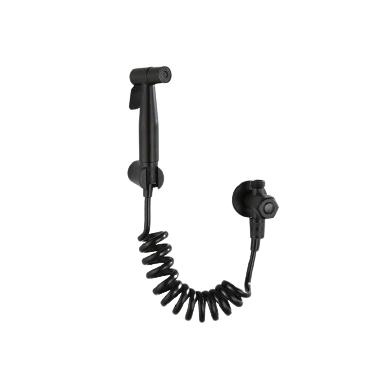
A thermostatic bidet sprayer delivers a constant water temperature, even in the event of a sudden pressure variation in the network. Say goodbye to thermal shocks: it provides maximum comfort, which is particularly appreciated by children and sensitive individuals.
Its stainless steel body combines robustness with heat-resistant internal parts. This type of sprayer requires a hot water supply nearby and regular maintenance to prevent deposits from blocking the mechanism. Its regulation system also limits hot water waste.

See the thermostatic bidet sprayer
Choosing your sprayer based on sprays and water flow
The type of spray and the flow rate are determining factors for your daily comfort and water savings.
Spray modes, from gentle rain to tonic massage
Plastic models often offer one or two basic modes. High-end models, especially those made of stainless steel, offer a full range of sprays to vary sensations.
- Rain spray: a gentle and enveloping flow, perfect for sensitive areas, without the slightest risk of irritation.
- Concentrated spray: powerful and targeted for meticulous cleaning — also practical for rinsing the bowl.
- Pulsating spray: a rhythmic succession that provides a massaging effect, traditionally sought after for its toning effect on local circulation.
- Massage spray: it combines cleaning efficiency with a sensation of well-being.
Flow control is available on most models equipped with a trigger. It is also possible to adjust the power at the wall mixer.
The anti-drip function, present on many models, eliminates residual leaks. Thermostatic systems also incorporate a limiter, which automatically reduces water consumption while maintaining temperature.
Shower head or bidet sprayer head?
Shower heads are designed for the bathroom: they attach to a hose connected to the bathtub faucet, offer several spray modes, and are intended to cover the entire body.
Bidet sprayer heads, on the other hand, are installed directly next to the toilet, connected to the toilet flush supply. They focus on intimate hygiene with a targeted spray that is adjustable in intensity and sometimes temperature. Unlike a shower head, a bidet sprayer must remain small and manageable to easily pass between the legs — hence why the heads are shorter and thinner.
In summary: the shower head is for the entire body in a context of well-being, while the bidet sprayer is for precise and hygienic cleaning of intimate areas.
Installation and maintenance of your bidet sprayer
Installing a bidet sprayer is a simple operation that requires no real plumbing work. Regular maintenance will then preserve your comfort over the long term.

Simple assembly, with a T-connector
The installation is done via a standard T-connector, usually made of brass. It connects without any modifications to your plumbing, as watertightness is ensured by simple seals.
Some models have a screw-in wall mount, while others include a mount that sits on the tank without drilling.
Teflon tape on the threads is essential to ensure a watertight seal — especially on stainless steel parts.
| Material | Tools required | Installation time | Drilling | Difficulty |
| ABS plastic | Adjustable wrench, screwdriver, Teflon tape | 10-15 minutes | Optional | Easy |
| Stainless steel | Adjustable wrench, screwdriver, Teflon tape | 10-15 minutes | Optional | Easy |
| Thermostatic | Adjustable wrench, screwdriver, Teflon tape | 20-30 minutes | Yes | A bit more technical |
The provided hose is generally 120 cm long, an ideal length that adapts to almost all configurations.
Thermostatic models require two connections to mix hot and cold water, but remain compatible with most installations. A DIY enthusiast can manage this without a professional.
To learn more, see our article: How to install a bidet sprayer.
Descaling and maintenance according to material
Taking care of your bidet sprayer extends its lifespan. Each material requires specific attention.
- Plastic: a daily rinse with water is sufficient, supplemented by occasional descaling with white vinegar.
- Stainless steel: a soft cloth preserves the shine; an anti-limescale product maintains the power of the sprays.
- Thermostatic: check the mechanism once a year to prevent deposits and ensure setting reliability.
- Seals: check their condition annually and replace them if necessary to prevent leaks.
Smooth surfaces, both plastic and stainless steel, greatly facilitate daily cleaning. Regular maintenance prevents limescale from building up.
Frequently asked questions
Plastic, stainless steel, or thermostatic: how to choose?
Three criteria are enough: your budget, the frequency of use, and the level of comfort you are looking for.
The plastic model is perfect for a small budget or an auxiliary sprayer — second home, guest room.
For daily use and real resistance to limescale, stainless steel is the obvious choice. Finally, the thermostatic version offers the best experience: stable water temperature and reinforced safety, ideal for families with children.
Which flow rate to choose to save water without losing efficiency?
Thanks to their optimized design, bidet sprayers regulate flow to the liter: pressure remains very effective despite low consumption. A thermostatic sprayer equipped with a flow limiter is the best choice to combine performance and savings.
To give you an idea: a wash uses about half a liter of water, while the manufacture of a single roll of toilet paper requires 140.
Do you need a plumber to install a bidet sprayer?
No. The vast majority of installations are simple and do not require a professional. With a T-connector and a little Teflon tape, the assembly is done in about ten minutes. Only a thermostatic sprayer might justify professional intervention.
Whether you have chosen plastic or stainless steel, the method is identical and involves no modification to your plumbing. Only specific PRM (people with reduced mobility) models, or a complex wall mount, may require the help of a professional.

To go further, read our article on the differences between a bidet and a bidet sprayer.