

Japanese Toilets: Pros and Cons
Japanese toilets are attracting more and more users in Europe. Long perceived as high-tech equipment reserved for Japan, they are becoming mainstream thanks to much more accessible solutions. But before choosing, many wonder: what are the real pros and cons of Japanese toilets?
These washlet toilets are based on a simple principle: instead of just toilet paper, they clean your intimate areas with a directed water jet. The result is a sensation of complete cleanliness and unparalleled comfort.
In this article, we analyze the pros and cons of Japanese toilets, their operation, their use, as well as the various models available.
What is a Japanese toilet and how does it work?
A Japanese toilet is a toilet equipped with a water-washing system intended to replace or supplement toilet paper.
Its operation relies on several components:
- one or more nozzles located under the seat;
- water jets that provide cleaning;
- sometimes a drying and heating system;
- pressure and temperature settings;
- a remote control or a control panel.
After using the toilet, the user activates the washing jet, which sprays water under the bowl to clean the area. The system can then follow up with a warm air drying cycle.
Depending on the model, there may also be a heated seat, an integrated water heater, an automatic flush, or an automatic nozzle self-cleaning cycle.
The different types of Japanese washlet toilets
Before analyzing the advantages of Japanese toilets, we must distinguish the three main categories on the market.
The electric Japanese monobloc toilet
The complete Japanese bidet is a toilet that directly integrates all technologies. These high-end models generally offer:
- heated seat;
- temperature adjustment;
- warm air drying;
- remote control;
- self-cleaning nozzles;
- automatic lid opening.
It is the most advanced experience in terms of comfort. On the other hand, their price is very high and their installation requires significant work. This type of model therefore remains rare in Europe.

The electric Japanese toilet seat
The Japanese toilet seats are the most popular solution.
It is a seat equipped with a washing system that simply replaces the existing seat. It is attached to the bowl, then connected to water and electricity.
Its features are very similar to those of a complete toilet:
- adjustable water jets;
- warm air drying;
- heated seat;
- pressure adjustment;
- temperature adjustment;
- remote control.
This option offers remarkable comfort while remaining much more economical than a monobloc. The installation is very simple and can be done without a professional.

The non-electric Japanese toilet kit
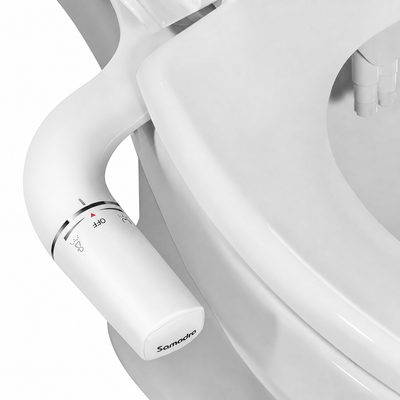
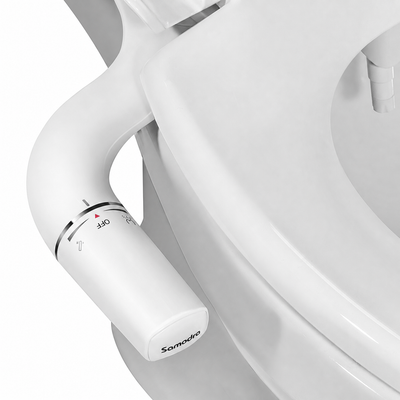
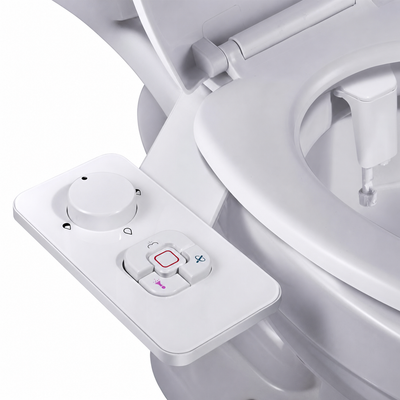
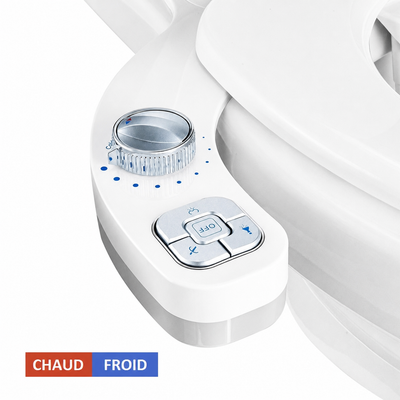
Third category: the non-electric Japanese toilet kit, also called a bidet kit or Japanese hand shower.
It simply attaches under your existing seat. It is a purely mechanical device that works solely on water pressure:
- connection to the water supply;
- pressure adjustment dial;
- retractable nozzles for washing.
These Japanese toilet kits are very practical and particularly economical. They already offer the essentials of excellent intimate hygiene.

The advantages of Japanese toilets
They are numerous and explain the growing popularity of this equipment.
Significantly superior hygiene
This is the main benefit. Washing with water is much more effective than using toilet paper alone: the jets clean the area directly, where paper only wipes.
It is also the most commonly recommended habit for people prone to itching or irritation.
True daily comfort
The heated seat, the water temperature setting, and the warm air drying make every visit much more pleasant.
Reviews all agree on this point: it is a level of comfort that truly changes daily life.
A more ecological solution
Washlet toilets are also much more ecological: paper consumption drops by 70 to 90%.
Even though washing uses water — less than a liter on average — this consumption is negligible compared to that of paper manufacturing: 140 liters of water for a single roll.
A strong reduction in toilet paper
With a washlet toilet, paper usage becomes minimal. Drying can even replace it entirely on electric models; other users prefer switching to washable towels.
This reduction translates directly into savings: it is estimated that a person saves an average of €90 per year on the purchase of rolls, or nearly €360 for a family of four.
The disadvantages of Japanese toilets
Despite all these advantages, a few points deserve to be known.
The initial investment
A monobloc toilet represents a significant investment: between €2,000 and €5,000.
An electric seat costs several hundred euros depending on the features — from €240 to €480 — but offers an excellent price-to-quality ratio.
As for non-electric models, they remain very affordable: from €60 to €110 for cold water, up to €170 with a hot water connection.
The need for an electrical outlet
High-end models require an outlet nearby. In some bathrooms, this seriously complicates installation. Non-electric versions completely solve this problem.
Maintenance and limescale
Like any equipment that uses water, limescale can build up in the nozzles. Regular maintenance is therefore necessary to preserve flow.
Fortunately, most models feature automatic nozzle rinsing. You can also add a sediment filter upstream of the water supply to limit limescale and residue.
A short adjustment period
The use of a washlet toilet can be surprising at first: one must get used to the sensation of the jet.
But after a few uses, almost all users never want to go back to conventional toilets.
Should you choose a Japanese toilet?
The choice depends mainly on budget and the level of comfort desired.
Monoblocs offer the most complete experience but remain very expensive.
Japanese toilet seats represent the best compromise between price, functionality, and ease of installation.
Non-electric kits are the simplest and most economical solution to discover water-based hygiene without changing your bowl.
Final verdict: pros and cons
Pros:
- better hygiene;
- a sharp reduction in toilet paper;
- incomparable comfort;
- an ecological and economical solution.
The cons mainly concern the initial cost and the installation of certain models.
In the vast majority of cases, the advantages of Japanese toilets far outweigh their limitations. Once adopted, this system very quickly becomes essential.